Artificial intelligence may be taking jobs, but what it's really doing is revealing leadership intent.
A recent Fast Company article by Bud Caddell helped crystallize how: the AI systems leaders build encode what they actually believe about their people.
Every AI strategy answers a fundamental question: Do you believe people are creative and motivated — or lazy and in need of control?
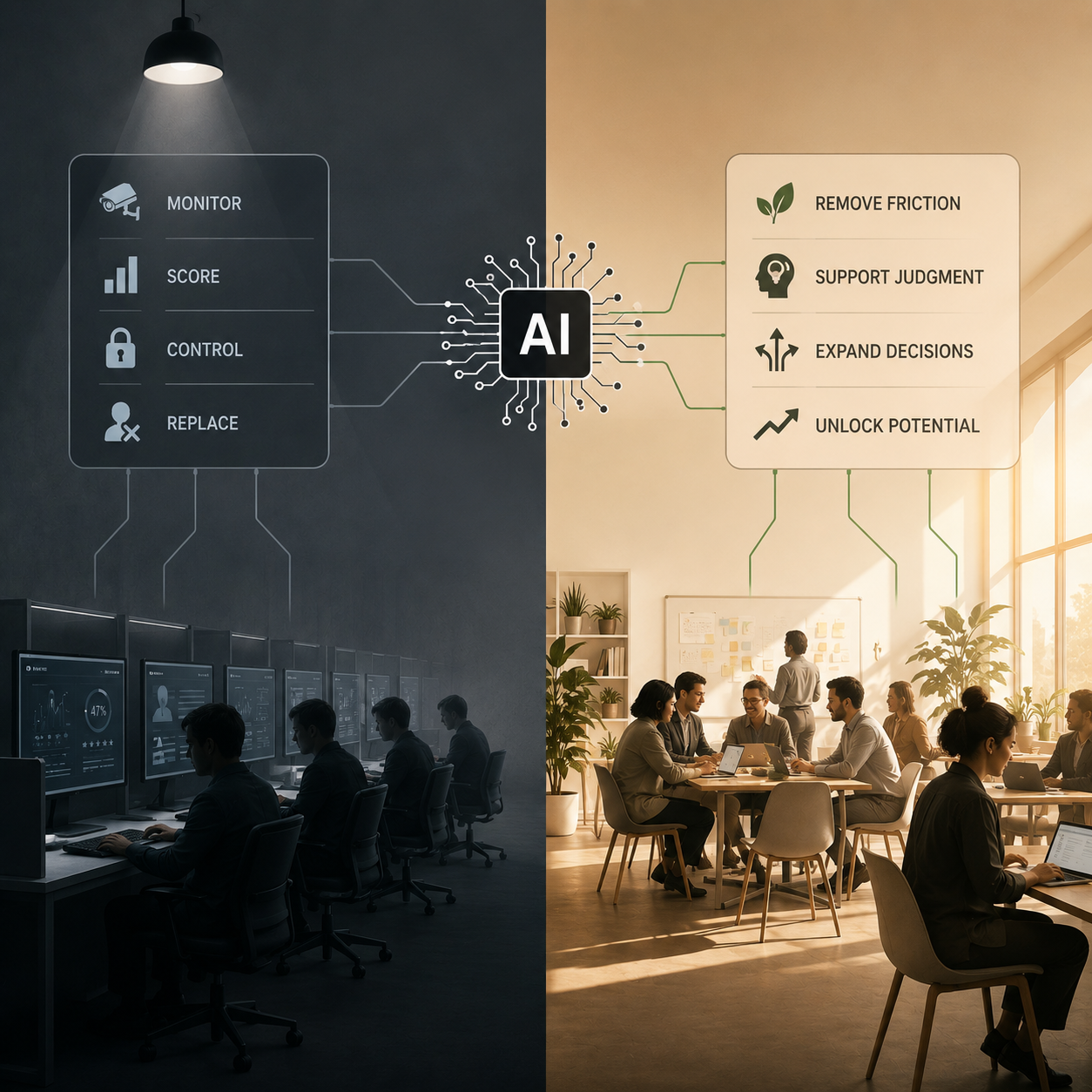
You can see the answer in the systems organizations choose to build. Surveillance, scoring and replacement logic assume mistrust. Systems that remove friction, support judgment and expand decision-making assume capability.
The technology may be new, but the leadership philosophy behind it is not.
AI Strategy Is Organizational Design
Caddell connects this dynamic to Douglas McGregor's Theory X and Theory Y, the management framework that argues leaders operate from hidden assumptions about human behavior.
- Theory X assumes people dislike work and must be directed, monitored and controlled.
- Theory Y assumes people are capable, self-motivated and able to exercise judgment when given the right conditions.
Those assumptions shape management systems. Over time, they often become self-fulfilling.
The same pattern is emerging with AI. Organizations deploying AI primarily to monitor productivity, score performance or reduce headcount are expressing one set of beliefs. Organizations deploying AI to eliminate friction, accelerate learning and support better decision-making are expressing another.
The technology changes. But the underlying leadership philosophy remains remarkably consistent.
Why Human-Centered AI Matters
We've all seen this play out at work. Personally, I'm firmly in the Theory Y camp.
Throughout my career, I've architected structures focused on clarity, goal alignment and giving teams latitude to create. I've watched team members stretch well beyond their own expectations when given ownership, trust and the space to exercise judgment.
Ownership rises. Judgment sharpens. First-in-kind innovation becomes possible. Not because technology replaces humans, but because it stops constraining them.
This is where many discussions about AI and the future of work miss the point. The most important question isn't what AI can do; it's what leaders choose to do with it.
AI Is Not Neutral
AI is often discussed as though it were an objective force acting upon organizations. But it isn't.
The systems we build reflect the assumptions we hold. They encode our beliefs about trust, work, accountability and human potential.
Which means AI isn't neutral. It's becoming one of the clearest mirrors leadership has ever had.
And as AI becomes more deeply embedded in how organizations operate, the systems leaders deploy will increasingly reveal what they believe about the people they lead.
At Stratespheric, we help leadership teams translate AI from boardroom priority to operational reality — clarifying where to place bets and how to build the capabilities that make them pay off.
Key Takeaways
- Every AI strategy reflects underlying assumptions about people and work.
- AI systems can either reinforce control or expand human capability.
- Douglas McGregor's Theory X and Theory Y remain highly relevant in the AI era.
- Human-centered AI focuses on removing friction, supporting judgment and enabling better decisions.
- The future of work may be shaped less by AI itself and more by the leadership philosophies encoded within it.