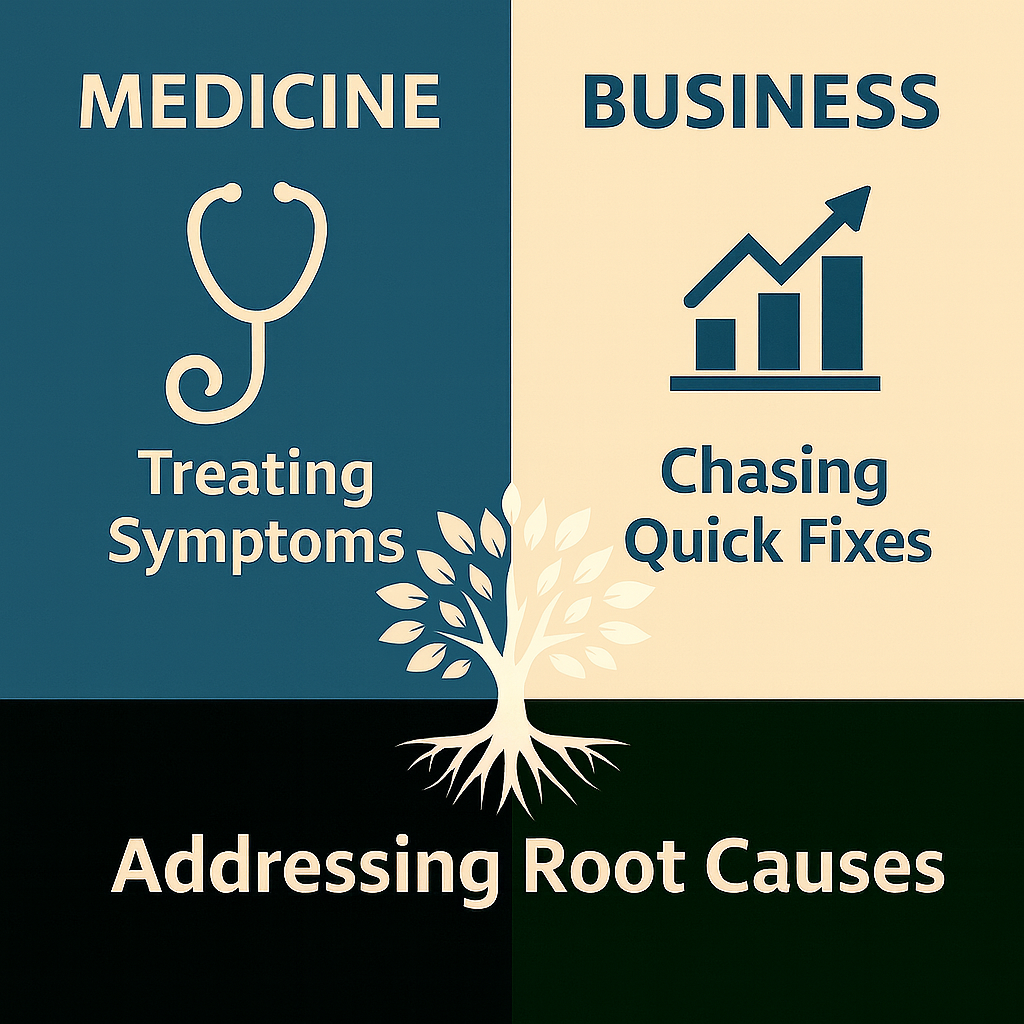
Most companies are chasing the next playbook, tactic or AI-enabled shortcut. Far fewer are examining the underlying systems shaping their go-to-market momentum. Yet the difference between sustainable growth and chronic GTM stagnation comes down to one thing: how you diagnose the system itself.
Interestingly, medicine offers one of the clearest parallels — because the shift from symptom treatment to root-cause discovery mirrors an evolution happening in today's commercial strategy.
The Problem: We're Chasing GTM Symptoms, Not Systems
There's so much talk across industries about the next go-to-market playbook, yet the same pattern keeps showing up: organizations diagnose pain points, not systemic drivers.
Operators rush to alleviate tactical challenges without understanding the deeper forces creating friction in the first place. That same instinct — to pour more into acquisition rather than fix the system underneath — is the focus of Before You Pour Another Dollar Into Ads.
It mirrors the long-standing challenge clinicians in the U.S. healthcare system face — operating in an embedded infrastructure that encourages treatment of highly specific, visible pain vs. applying a more holistic assessment to understand the root cause generating it.
Just as medicine is now advancing precision-based, systems-level diagnostics and richer data, so too are commercial operators utilizing new tech innovations and data.
But many ask the wrong question.
Not: What's the symptom we're feeling?
Instead: What system produced it?
The GTM Symptom Cycle
When teams treat symptoms instead of systems, the same patterns recur:
Symptom: Soft pipeline → Add ad spend or hire from a "hot logo"
Root causes often look like:
- Misaligned ICP
- Outdated or undifferentiated positioning
- Limited brand awareness
- Mismatch in hiring (operator can't sell at your growth stage)
Symptom: Declining engagement → Buy another tool
Root causes often look like:
- Message–market disconnect
- Friction in handoffs
- A mispriced offer
- No wedge product to ignite early advocacy
Symptom: Slowed momentum → Swap tactics or teams
Root causes often look like:
- Skipped operational audit
- No sprint-level feedback loops
- Scaling too early without discovery
- Out-of-order sequencing across product, marketing and sales
Symptoms are visible.
Systems are causal.
Until you study the system you're operating in, you're only treating the pain — not the root cause.
What Medicine Gets Right — And Why It Matters for GTM
The U.S. healthcare system is far from perfect. Yet commercial operators can take one page out of their playbook to move forward. More clinicians are employing systems-based precision analysis that integrates feedback loops, data integration and pattern recognition to identify underlying drivers of disease.
Rather than episodic treatment, they're focusing more on:
- tracing patterns
- mapping dependencies
- uncovering triggers
- measuring response
- refining intervention
This systems-first thinking is the exact shift that commercial GTM requires.
GTM Maturity Is an Art and a Science, Not a Tactic
Growth maturity doesn't come from the next playbook or tool. It comes from treating GTM as both art and science — a living system you test, measure and evolve.
When growth teams operate like clinical teams:
- Diagnosis precedes prescription
- Dependencies are mapped before deployment
- The full system is treated — not the isolated pain point
Playbooks then evolve into dynamic artifacts: capturing learning, highlighting causal relationships and enabling more precise interpretation of where the commercial engine needs calibration.
This work starts long before "scale" arrives — and it's how the organizations that scale sustainably avoid plateaus, misfires and costly resets.
Why This Matters With High-Stakes Growth
Stratespheric's work across product launches, channel expansions, brand repositioning, AI integration and revenue plateaus reveals the same truth: the core of a GTM problem rarely stops at the symptom.
- Looks like a marketing issue → often a positioning issue
- Looks like a sales problem → often a sequencing or ICP problem
- Looks like an attrition problem → often a system friction problem
- Looks like a tool issue → often a workflow or messaging issue
Teams stall when they misdiagnose.
Teams accelerate when they study the system.
The Throughline
Businesses that scale sustainably transform their episodic treatment of issues into high-precision assessment and optimization:
- Diagnose before prescribing.
- Map dependencies before deploying.
- Treat the system, not the symptom.
Playbooks and software still matter — but only inside a living, learning, adaptive system.
Lasting progress in health and in business begins when we stop chasing pain and start studying patterns. Because the faster you find the root cause, the faster you're ready to start scaling again.
Key Takeaways
- Most GTM stagnation is a diagnostic failure, not a playbook gap — organizations treat symptoms rather than the systems producing them.
- The GTM symptom cycle repeats because root causes (misaligned ICP, weak positioning, sequencing gaps) go unaddressed while teams chase tactical fixes.
- Medicine's shift to systems-based precision analysis offers a direct parallel: trace patterns, map dependencies, uncover triggers — before prescribing.
- GTM maturity means treating go-to-market as a living system: diagnosis precedes prescription, and dependencies are mapped before deployment.
- Teams that study the system rather than react to symptoms avoid costly plateaus, misfires and resets — and scale with far greater precision.