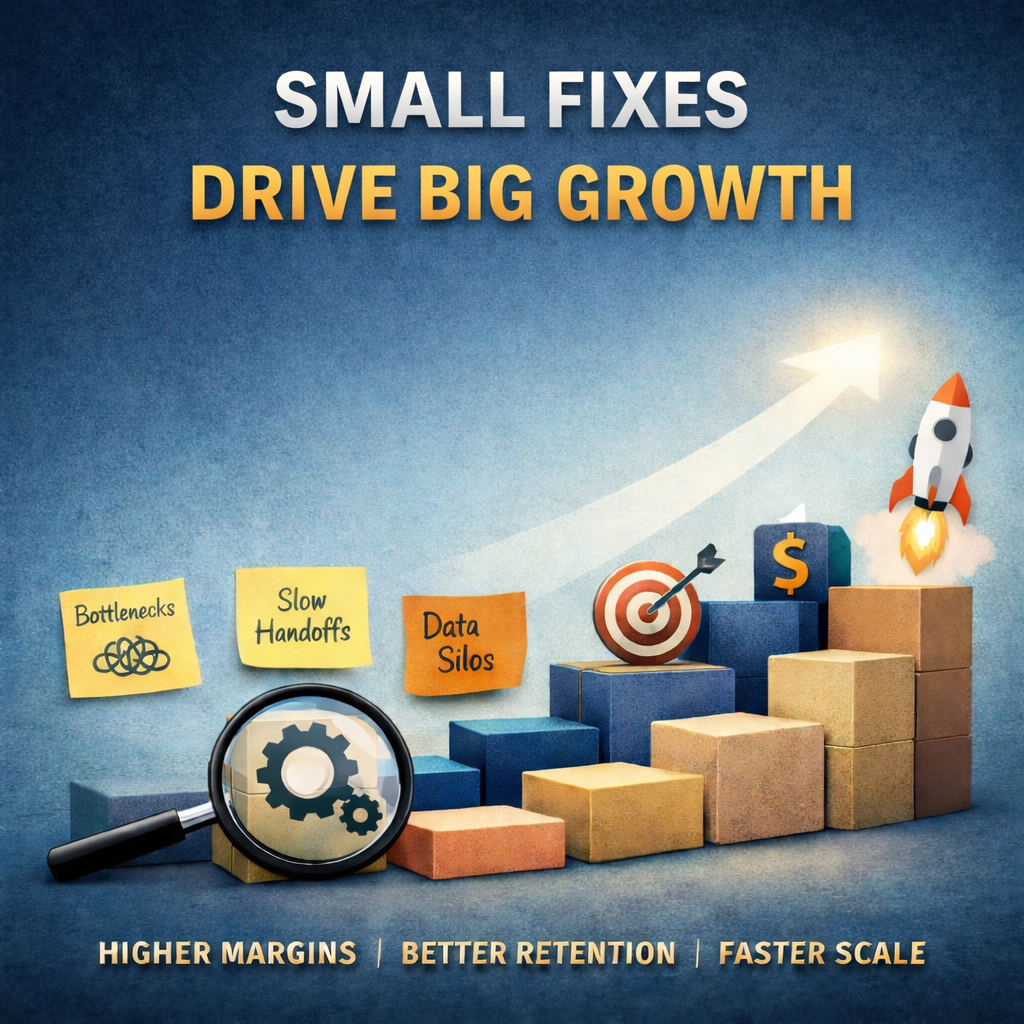
Many teams chase the next big breakthrough initiative, yet most growth slips away through small, persistent issues they've learned to tolerate or ignore.
A misaligned handoff. A reporting delay everyone works around. An onboarding task that takes three clicks too many. Siloed data that is never consolidated into a core system.
None of these issues feels strategic on its own. Collectively, they shape how work actually moves through the organization.
Micro-Gaps Are Signals
Those small gaps are not operational noise. They are signals. They show where your system is out of sync with how your team or customers actually move.
Over time, people adapt around these inefficiencies. Workarounds form. Friction becomes normalized. At scale, the lost time and energy do not stay small. They multiply.
As organizations layer in AI tools and integrations, this effect intensifies. Automation can compress friction out of a system — but it can also amplify misalignment if the underlying workflows were never designed coherently.
Start Where the Friction Is Felt Daily
If you are not sure where to start, ask your team a simple question: What slows you down by 2% a day?
Most teams already know the short list. They have simply stopped flagging it because the issues feel too small to fix amid larger priorities.
Yet addressing three to five of these constraints at once can materially shift a growth trajectory. Small, aligned improvements do not just add up. They compound — a dynamic explored in depth in Force Multipliers in Plain Sight: The Overlooked Systems That Compound Growth.
Why Small Improvements Create Outsized Impact
When micro-frictions are removed in parallel, multiple performance levers improve at once. Margins increase as wasted effort is eliminated. Average contract value grows as experiences become smoother and more reliable. The CAC to LTV ratio strengthens before a single new customer is added.
This is growth through operational leverage rather than expansion alone.
What Compounding Improvements Look Like in Practice
Some of the most enduring growth stories were built on changes that did not sound revolutionary at the time.
- Dropbox embedded its referral step directly into onboarding, a subtle UX shift that helped grow registered users from roughly 100,000 to more than 4 million.
- Superhuman re-engineered onboarding into a structured, scalable playbook, transforming what had been a bottleneck into a retention engine.
- Zapier built an entire business around automating small, repetitive internal tasks, freeing teams to focus on higher-value work instead of administrative drag.
Individually, these were modest interventions. Together, they created momentum that scaled.
Fixing What Is Already Broken
Your next big growth lever may not be a new initiative. It may be fixing the small things your team already knows are broken.
In systems that compound, progress rarely comes from doing more. It comes from removing the friction that prevents what you are already doing from working harder.
At Stratespheric, finding what's already working — and building deliberately around it — is how we help companies unlock growth without overhauling what doesn't need fixing.
Key Takeaways
- Most growth doesn't slip through big strategic failures — it erodes through small, tolerated friction points.
- Micro-gaps are signals, not noise. They reveal where your system is out of sync with how work actually moves.
- AI amplifies what's already there — coherent systems get faster; misaligned ones get more chaotic.
- Addressing three to five friction points in parallel creates compounding impact, not just incremental gains.
- Your next big growth lever may already be visible. It's the small thing your team stopped flagging because it felt too minor to fix.