Healthcare's next battleground may not be in the clinic.
It may be in the moment before someone decides they need care.
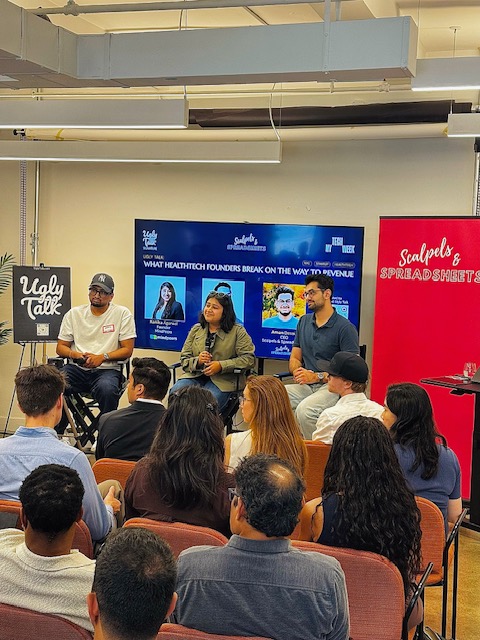
That was a key takeaway from the New York Tech Week 2026 session, UGLY TALK: What Healthtech Founders Break on the Way to Revenue.
While the discussion covered fundraising, pilots and go-to-market challenges, a larger theme surfaced: competitive advantage is shifting toward the organizations that identify intent, earn trust and influence decisions earlier in the patient journey.
Outcomes Are Becoming the Differentiator
As AI becomes table stakes across healthcare, enterprise buyers are less interested in technology alone and more interested in measurable outcomes.
Kanika Agarwal, Founder of MindPeers, shared a simple question she uses to anchor every enterprise conversation:
"Can I help this organization reduce healthcare costs?"
Her north star metric is Total Care Cost Offset.
It's a useful reminder that healthcare organizations are not buying AI. They're buying improved outcomes, lower costs and better operational performance. The organizations gaining traction are translating AI into operational and financial value that enterprise buyers can readily measure.
Healthcare and Adtech Are Beginning to Converge
One of the more interesting conversations centered on patient intent.
Osama Usmani, Founder and CEO of Salubrum, is building infrastructure that identifies when patients are approaching care decisions and enables healthcare organizations to engage them earlier.
The parallels to adtech are difficult to ignore:
Intent signals.
Audience intelligence.
Predictive engagement.
Hyper-personalization.
The difference in health is that the stakes are significantly higher.
What makes these developments particularly interesting is that healthtech is beginning to develop its own intent infrastructure. Just as adtech learned to identify and engage consumers before a purchase decision, healthtech is beginning to identify and engage patients before a care decision.
Healthcare organizations have historically focused on the point of care. The next competitive advantage may come from understanding the moments that precede it.
Distribution Wins. Trust Is the Mechanism.
Both founders emphasized a reality that extends far beyond healthcare: technology may be the entry ticket, but distribution is the moat. And trust is what enables distribution.
In healthcare, trust is rarely built from scratch. It's often accessed through the people and institutions that have already earned it.
Osama described how this realization led him to deploy a different go-to-market strategy. Rather than relying exclusively on product demonstrations and outbound outreach, the company invested in experienced operators with decades of institutional credibility and trusted relationships.
The lesson is broader than healthcare. In complex and regulated markets, trust often travels through people before it travels through products or innovation.
Positioning for a Post-AI-Bubble Market
One of the most candid discussions expanded beyond product development to capital strategy.
Osama noted that some founders are extending runway while valuations remain elevated, using the window to maximize token capacity, secure scarce talent and build durable advantages designed to outlast the current AI hype cycle.
The goal is not simply to participate in today's market.
It's to strengthen the capabilities that will matter after conditions change.
The New Healthcare Advantage
Zooming out, timing emerged as the defining advantage. Healthcare's next leaders will shape the patient journey upstream, long before a patient decides to seek care.
At Stratespheric, we work with healthtech and commercial leaders navigating this shift — helping them identify where upstream advantage is being built and how to position for it before the window closes.
Key Takeaways
- Healthcare decisions are increasingly being influenced before patients enter the care system.
- As AI becomes more widely available, outcomes are emerging as the primary differentiator for enterprise buyers.
- Patient intent infrastructure is creating new opportunities for earlier engagement — drawing on tools and thinking pioneered in adtech.
- Trust remains a critical component of healthcare distribution and adoption — and it often travels through people before it travels through products.
- The next generation of healthcare leaders will compete not only at the point of care, but at the point of intent.