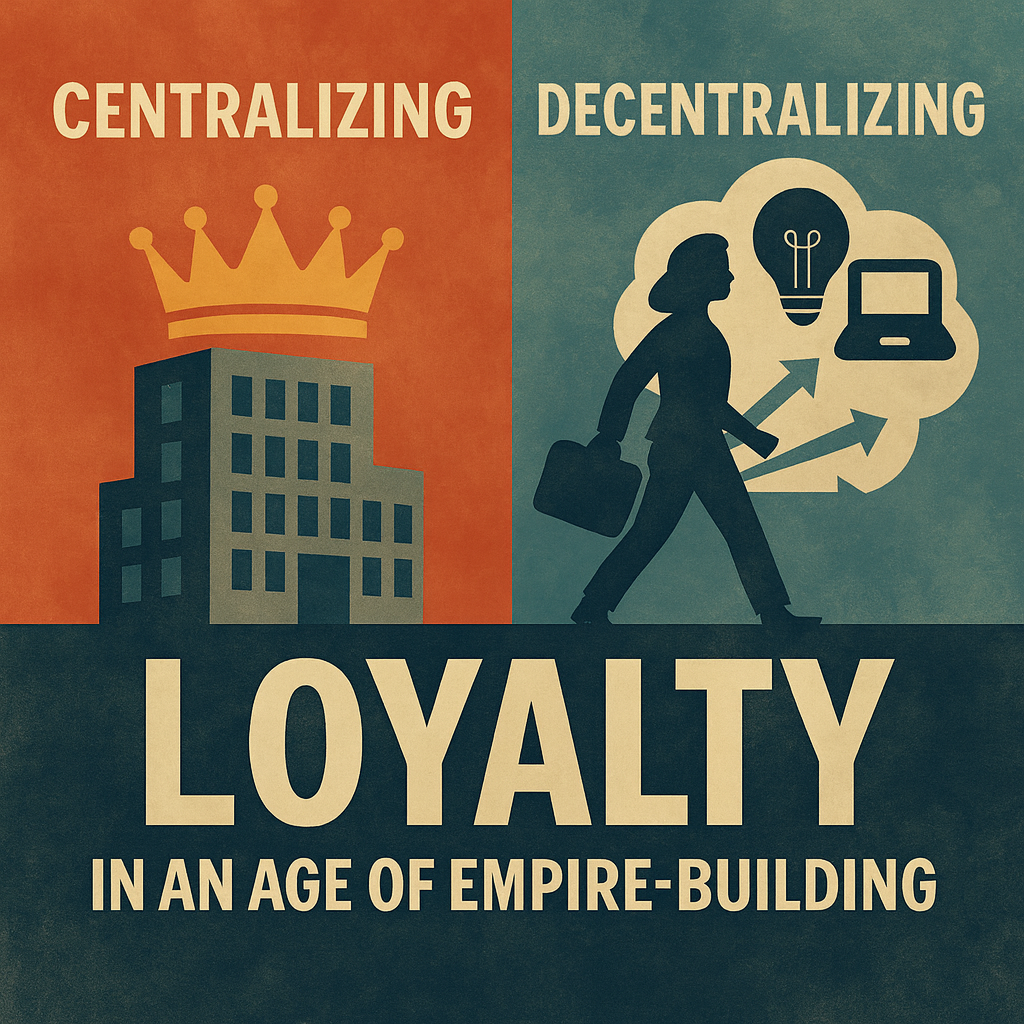
We're watching two opposing forces unfold in real time.
1) Companies are centralizing, pulling capability, capital and intelligence into the core. And AI is accelerating this shift: enabling exponential scale, automating workflows and consolidating data streams that once lived across teams and tools.
2) At the same time, talent is decentralizing. People are choosing fractional work, portfolio careers and entrepreneurial paths over linear ladders. The most capable operators — those who've navigated launches, plateaus, rebrands, AI integrations and high-stakes transformations — are increasingly designing their own ecosystems of contribution.
This tension between centralizing empires and decentralizing talent is redefining how work happens and where commitment lives.
Why the Old Loyalty Contract No Longer Holds
In this dual system, the traditional top-down model of loyalty simply doesn't map.
Loyalty is no longer defined by tenure, titles or the promise of a multi-decade path upward. It now forms in a constellation structure — dynamic, portable and shaped by the conditions that enable people to do their best work.
Three patterns are emerging:
Modular Loyalty. Trust that moves from one engagement to the next, influenced by quality of execution rather than length of employment.
Reciprocal Loyalty. Commitment grounded in transparency, shared context and mutual growth — not in long-term retention mandates.
Networked Loyalty. Allegiance that forms across communities, collaborators and shared missions rather than inside a single company.
We're loyal to impact.
We're loyal to reputation.
We're loyal to the environments that empower us — the ecosystems that enable clarity, momentum and meaningful work where we can create value the fastest.
Not necessarily to the organizations where we are employed with the longest.
What Centralization Actually Means Today
Centralization is no longer just structural — it's operational.
Companies are consolidating data intelligence, workflows, decision-making and capital under increasingly integrated systems.
This creates economies of scale, but it also compounds complexity, which can quickly turn into silos, misalignment and human disconnection — a cost that compounds in ways most organizations underestimate, as covered in The Organizational Cost of Velocity:
- workflows become more interconnected
- decision cycles can lengthen as stakes rise
- data compounds faster than teams can absorb
- interdependencies increase the cost of friction
That's why centralized systems require a different kind of talent — not only people who can navigate across silos, unblock execution and activate the right growth levers, but also leaders who every single day can bring clarity, context, alignment and meaning to the work and the teams delivering it.
And as talent decentralizes, people gravitate toward environments where:
- blockers are removed quickly
- expectations are explicit
- execution is sequenced, not chaotic
- growth is mutual
- politics don't outpace progress
This is what shows up inside the pivotal growth moments Stratespheric specializes in: new product and channel launches, GTM recalibrations, repositioning, revenue plateaus and AI integration.
These transitions reveal whether an environment creates energy or drains it — and whether it generates loyalty or repels it.
For Leaders, This Changes Everything
Retention policies and perks no longer drive loyalty.
People stay where the conditions to deliver great work exist.
The next loyalty advantage comes from establishing orbit — creating the gravitational pull that draws great talent in and keeps them within your field of gravity, regardless of employment structure.
Orbit is not control. It's connection. It's built through:
- clarity and transparency
- momentum
- clean ownership
- systems that accelerate rather than stall
- environments that respect expertise
In an era where companies are building empires while talent chooses ecosystems, orbit becomes one of the most durable leadership advantages available.
The Throughline
Centralization isn't slowing down.
Decentralization isn't reversing.
Loyalty now lives between the two — shaped by trust, impact and environments that enable people to contribute at full capacity.
In an age of empire-building, loyalty doesn't scale by command. It scales by connection.
Key Takeaways
- Companies are centralizing while talent decentralizes — this tension is reshaping how loyalty forms and where commitment lives.
- The old loyalty contract (tenure, titles, linear paths) no longer maps to how the most capable people work today.
- Three new patterns are emerging: Modular Loyalty, Reciprocal Loyalty and Networked Loyalty — all shaped by quality of environment over length of employment.
- Centralized systems require leaders who can bring clarity, context and alignment daily — not just people who navigate silos.
- The next loyalty advantage is establishing orbit: a gravitational pull built through transparency, momentum, clean ownership and systems that accelerate rather than stall.