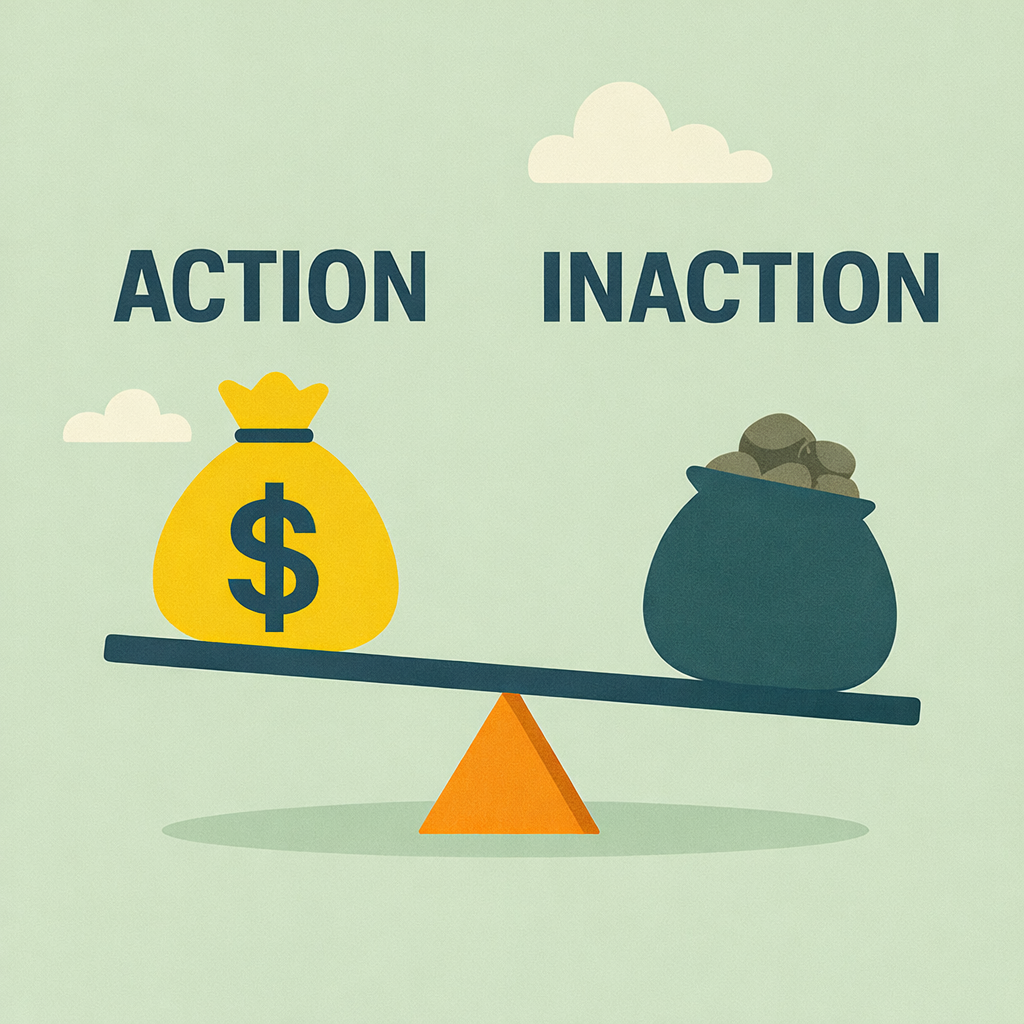
We tend to overestimate the risk of action and underestimate the cost of inaction. While decisions sit in limbo, competitors use that same time to pull ahead.
What would those delays have been worth if you'd acted sooner?
A new client secured.
A category window captured.
A compounding advantage now accruing to someone else.
In fast-moving markets, waiting is not neutral. It is a choice with consequences.
Quantifying the Upside You're Deferring
Most teams debate decisions qualitatively. Fewer pause to quantify what hesitation is actually costing them.
Consider a few common scenarios.
1. A 10% Workflow Improvement
Committing to a 10% workflow fix for a team of ten data and DevOps engineers can translate into roughly $1.2–$1.5M in annual value. That is not theoretical efficiency. That is capacity — either gained or forfeited.
When improvements are delayed, the loss compounds quietly across every sprint, handoff and release cycle.
2. Hesitating on Foundational GTM Work
Many teams hesitate to invest in foundational go-to-market work: positioning, ecosystem development, a content engine or sales architecture.
Yet if that work pulls forward even one enterprise deal by 60–90 days, the return can exceed the original investment many times over.
Timing matters. Revenue realized earlier is not just revenue — it reshapes momentum, confidence and downstream opportunity.
3. Debating a Lite Product Offering
Mulling over whether to launch a lightweight product often feels like a strategic distraction. But a $199 self-serve product that grows top-of-funnel by 25% and cuts a 120-day enterprise cycle by a third can unlock faster monetization and earlier upsells.
The question is rarely whether it works in theory. It's whether the delay costs more than the experiment.
How Micro-Changes Compound
Small changes can scale faster than expected. A single in-cart upsell that boosts conversions and ACV. A contract flow that shrinks from fourteen days to four. Onboarding optimizations that accelerate time-to-value.
These are not sweeping transformations. They are targeted adjustments whose impact multiplies over time.
Tiny fixes.
Massive compounding.
The Downside of Waiting
The cost of waiting is not limited to missed upside. Companies routinely defer basic upgrades — cybersecurity is a common example — until a breach wipes out millions in contracts, penalties and reputation.
Any prior "savings" become the most expensive decision they ever made.
The risk was always there. The delay simply concentrated it.
The Real Question
The real question is not what action will cost you. It is what waiting is costing you every single day.
In competitive markets, inaction has a price tag — even if it never shows up on a budget line.
At Stratespheric, we help leadership teams calculate what staying still is actually costing — and build the case for action that gets organizations moving before the window narrows further.
Key Takeaways
- Inaction is not neutral — it has a compounding cost that rarely appears on a budget line.
- A 10% workflow improvement for a small engineering team can translate to $1.2–$1.5M in annual value.
- Pulling an enterprise deal forward by 60–90 days through earlier GTM investment can return many times the cost.
- Small, targeted changes — in contracts, onboarding, in-cart flows — compound significantly over time.
- The real question is not what action will cost you. It is what waiting is costing you every single day.